Home Blog Page 8

First Lion Cubs in 10 years Spotted at Liuwa, Zambia

0

Two lion cubs have been sighted in Liuwa Plain National Park in Zambia, significantly marking the first birth of lion cubs in the park for well over 10 years. They were born three to four weeks ago to the protégé of the park’s famous lioness known as Lady Liuwa.

It is believed that this is the lioness’s second set of cubs and that she probably lost her first set due to inexperience. The father of the cubs is the park’s only male lion. The lioness has hidden her new cubs in thick bush, making it difficult to photograph them.

For more than nine years Lady Liuwa was a solitary, lonely lioness roaming the grassy plains of the park in search of fellow felines with whom to mate and hunt, the sole survivor after massive poaching and illegal trophy hunting wiped out the species in the park in the 1990s. The extraordinary story of how she turned to humans for companionship and how the conservation team at Liuwa Plain National Park helped to find her a family became one of the most moving wildlife films of all time to screen on National Geographic TV in 2010. Lady Liuwa has a dedicated Facebook and other social media profiles and has also featured prominently in the international media.

Lady Liuwa’s protégé, the mother of the two newly born cubs, was one of two young females introduced from Kafue National Park in 2011. Her sister was killed by a snare in 2012 and she, probably traumatised by this event, ran away towards Angola. In a dramatic rescue mission she was darted, airlifted back to the park, and placed in a fenced boma. African Parks then took the decision to place Lady Liuwa in the boma to encourage the two lionesses to bond. After two months the two lionesses were released back into the wilds and have since been inseparable.

Two male lions, which were introduced to Liuwa from Kafue in 2009, also headed towards Angola in mid-2012 and one was reportedly shot dead by villagers in Angola.  His companion, who made it safely back to Liuwa is now the resident male in the pride and father of the two new cubs.

We are overjoyed to have sighted the cubs and will closely monitor the new offspring to minimise threats to them,” said Liuwa Park Manager, Raquel Filgueiras. “The birth of the cubs will help safeguard the future of lions in Liuwa and strengthen the park’s tourism offering. It is an event in which all stakeholders including ZAWA, the BRE (Barotse Royal Establishment), the Liuwa communities and the park itself can be proud.”
Kenya Increases National Park Entrance Fees

0

Kenya Wildlife Service (KWS) has raised the park entry fees by 33 per cent to $80 (Sh6,800) from $60 (Sh5,100) previously. This is the second time that the tariffs are being increased, as part of a two-phase plan first implemented in January 2011 where the rates were raised to $75 (Sh6,375) up from $60 (Sh5,100).

The new conservation fees were aimed at encouraging safari visitation during the low season in highly visited parks and reducing congestion during peak seasons to maintain the ecological integrity of wildlife zones.

In a press notice, KWS said the new prices would be applicable to Lake Nakuru, Amboseli, Tsavo East and West, Meru/Kora and Mount Kenya National parks during the high season months of January to March, July to August and from September to October.

East African residents will continue to pay Sh1,000 for entry to premium parks, while non-East African citizens will pay Sh1,000 up from Sh500 as at December 31, 2011.

The wildlife manager has defended the 20 per cent increase in tariffs, citing the improvement of infrastructure—such as securing of wildlife migration corridors and dispersal areas, opening up of tourism investment in under-utilised parks and reserves and management of specific wildlife population.

It also cited the rising costs of staffing, maintenance, improving security and government policy implications.

The government policy that parks should be self-financing has put pressure on KWS to turn to ways of raising the revenue it needs to cover its costs, including raising park fees.

It earned Sh2.7 billion from park fees alone in 2010, which accounted for 96.4 per cent of its total Sh2.8 billion turnover for that period.

Ecotourists find Uganda as a New Hotspot

0

Tourism in Uganda is becoming a booming business! More and more people see Uganda as a holiday destination as more tours are being offered in the region. In 2012, Uganda was voted among the 10 best destinations to visit by the Lonely Planet.

Compared to the more developed neighboring countries, Kenya and Tanzania, this troubled nation has been a slow starter in the region. Attributed to both domestic wars and political instability Uganda has not been visited by the mainstream tourists who have been taking safaris in Tanzania and Kenya.

In 1998 a fatal tragedy shocked the country and the world, when several Western tourists were killed in a hostage drama near Bwindi Forest National Park by the Interahamwe Rebels from the neighboring Rwanda. After this incident, the Uganda government has done a lot to tighten its security along its borders and in the past 14 years much has changed in the country. Tours are offered throughout Uganda and tourist explore the beauty that this unspoiled country has to offer. Uganda is eco-holiday destination number one.

A Uganda safari has it all. Stunning natural areas surrounded by cloud-covered mountains. Dropping valleys and gently sloping hills with flourishing green vegetation.

With all that beauty you might be worried that it will all get lost if mass-tourism hits Uganda. But that is where Uganda is one step ahead of the rest. The government puts nature preservation before tourism, to keep the nature unspoiled and beautiful.

All this talk of stunning beauty has gotten you curious, hasn’t it?

Two random examples of an amazing holiday in Uganda that you can go on are an expedition on the Nile, or visiting the mystical mountain gorillas on a gorilla trek in Bwindi Impenetrable National Park.

But there is much more!

Many birders have visited Uganda! This country hosts more than 1065 bird species including rare birds like the Shoebill stork.

So don’t hesitate! The beauty will blow your mind away!

Many travelers ask questions about Uganda

What is the safety factor for traveling in Uganda, working with villages, gorilla trekking etc.?

Uganda is a safe destination. Just like other destinations around the world, take caution while traveling through cities where there might be pick pocketers, thieves, etc.

What is the best time to visit Uganda?

Uganda can be visited all year round. Travelers can visit the gorillas and enjoy game viewing all year round though many prefer to visit the country during the dry season.

What is the best way to enjoy Safaris in Africa?

With reference to the gorilla safaris – They are still going and have done without problems, but please bear in mind these are well organized group tours and are secure.

What is the minimum age for gorilla trekking?

The minimum age for Gorilla Trekking is 15 years of age and applies to ALL of the protected areas. You can find any information on gorilla trekking from www.gorillatrekkinguganda.com

How safe would you say white water rafting is? and what injections would you need for there if u were camping for most of the time?

The rafting is a Grade 5 designation which means it can be pretty tough. A couple of different companies run the rafting in different spots and although the safety record and equipment used is good it is still a ‘extreme sport’. All care is taken obviously but nothing can be guaranteed when it comes to this type of activity.

It is advisable to contact your local GP or Travel Clinic for the latest updates on required immunizations for Africa. I would recommend Yellow Fever (don’t forget to get the certificate) and some malaria protection at the least.

Happy travels to Uganda, the Pearl of Africa!

Rwanda Launches new Tourism Trail

0

The Rwanda Development Board (RDB) has launched a 227km tourist trail, the Congo Nile trail, a new tourism product that is intended to boost the sector.

The trail bridges the western Rwanda corridor passing through five districts with Rubavu as the starting point all the way to Rusizi. A tourist on foot will take 10 days to complete the trail while one who chooses cycling will make it in 6 days while one driving will cover it in a day.

The hike includes many delights for a tourist, such as coffee and tea routes with twelve coffee washing stations, three tea factories and natural beaches along the shores of L. Kivu.

“Tourism is Rwanda’s number one foreign exchange earner so we must capitalize on this by diversifying and bringing more products on the market for tourists,” said Rica Rwigamba, RDB’s head of tourism and conservation.

RDB has in the past introduced new tourism products, including birding routes in Bugesera, Eastern Province and cultural products in Nyanza which you can check out during Rwanda safaris.

Poachers kill 23 Rhinos in Zimbabwe

0

Zimbabwe Parks and Wildlife Management Authority public relations manager Ms Caroline Washaya-Moyo said, 23 black and white rhinos had been killed this year in Zimbabwe national parks and conservancies.

However, 37 rhino poachers and illegal dealers in horns were arrested under an operation by the authority to protect the endangered species.

Ms Washaya-Moyo said the Zimbabwe Parks and Wildlife Management Authority endeavors to preserve the country’s wildlife heritage and has come up with a number of strategies to ensure protection of flagship species.

“This year, a total of 100 rhinos were immobilised for ear notching and horn implanting to facilitate individual identification and monitoring in the field and dehorned to create disinterest to poachers.” she said.

Rhinos remain a major target for poachers who sell their products in Asia and the Middle East where there is a lucrative market. The rhinos can be spotted during national park tours while on Zimbabwe safaris.

African Tourists to Rwanda Increase

0

According to statistics from Rwanda Development Board (RDB), African tourists dominated visits to Rwanda in the first semester of 2011, a phenomenon that indicates the country’s increasing attractiveness to the region and the entire continent.

African tourists to Rwanda increased by 28 per cent to 340,379 compared to the same period last year with the figure representing 84 per cent of 405,042 visitors that the country received.

Rica Rwigamba, the Head of Tourism and Conservation at RDB said, “Emphasis is to increase the leisure market and position Rwanda as a major leisure destination. We have done a good job in branding Rwanda as a safe destination, so now we need to talk more about leisure.”

Majority of the African visitors were from East Africa, South Africa and the DR Congo.

RDB indicates that Akagera National Park and mountain gorillas were the dominant attractions in 2011, while the canopy walk in Nyungwe Forest was the best selling product of all Rwanda safaris.

Kenya Wildlife Services Raises Park Fees

0

The Kenya Wildlife Service (KWS) has increased game park entry fees to boost its conservation efforts and reduce its dependence on the government.

KWS, the custodian of Kenya game parks, has introduced charges that will see the fees increase to $80 (Sh7,520) from a minimum of $60 (Sh5,640) on premium parks with immediate effect.

The Forestry and Wildlife minister Noah Wekesa also reviewed the fees structure by eliminating low and high season fees and introduced a flat rate charge in a bid to boost revenues.

Foreign visitors used to pay $60 (Sh5,640) during the low season at the premium parks (Amboseli and Lake Nakuru) and $75 (Sh7,050) during the peak seasons, which runs from January to March and July to October.

Dr Wekesa said the review is aimed at boosting KWS coffers to allow it meet its conservation obligations, arguing that the efforts are becoming expensive, causing the state-owned firm to run a huge deficit.

The increment will, however, only affect five top KWS parks, out of the 52 it manages and Kenyans will continue paying Sh500 at premium parks and Sh300 in others.

120 Rhinos Poached in South Africa in 75 days

0

As of today,  120 Rhino’s have been poached in 75 days. That equates to 1.6 rhino per day. If South African does not take drastic measures to curtail the slaughter, it is guesstimated that by the end of 2012, the number will be in the region of 600.

What a tragedy

120 Rhinos poached in 75 days, thats 1.6 rhinos a day, at this rate the toll will be close to 600 by year end.

The Return of Cheetahs to Angola!

0

Scientists saw cheetahs in southern Angola for the first time in three decades since the now-ended civil war devastated the animal’s habitat, a conservation group said Wednesday. After a three day survey in the arid Iona district of Angola bordering Namibia, cheetah specialist Laurie Marker reported the sighting of cheetahs!

Male cheetahs leave their droppings on trees as territorial markings, Marker reported to the Cheetah Conservation Fund, an international research organization based in this northern Namibian town.

“We found nine different marking trees,” he said. In one, he saw cheetah dung. Then “two male cheetahs ran out. It was very exciting – there are cheetahs in Angola!” he said. Cheetahs are the fastest of all cats and are found in few countries within Africa. A cheetah is known to run at speeds of 70mph (113km/hr)! The cheetah preys on deer and buck that have also returned to the 3.8 million acre (1.6 million hectare) Iona wilderness area designated a nature preserve.

The conservation group said that Marker used a Global Positioning System to record locations where he found likely cheetah prey, including one herd of about 1,000 springbok, a southern African gazelle known for jumping and running at speed when startled.

Amazing Facts About Sea Turtles

0
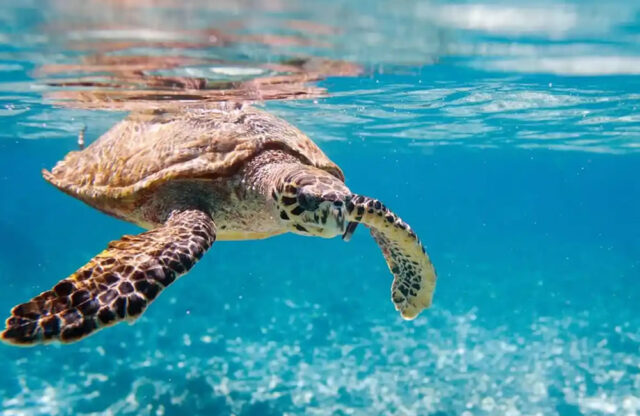
Seychelles Turtle

Sea turtles have lived in the oceans for at least 150 million years. They are found in ocean waters off all the continents with the exception of Antarctica.

They cover great distances foraging across the seas mainly for jelly fish, sponges, sea grasses, algae and pelagic crustaceans. One tagged leatherback has bean known to travel 2,700 miles from French Guyana to New Jersey. Another tugged in South Africa was found
in Malindi, Kenya.

There are eight species of sea turtles. In ascending order of carapace length, these are:
Olive ridley (Lepidochelys olivacea) 30 inches; Kemp’s ridley (Lepidochelys kempii)
30 inches; Hawksbill (Eretmochelys imbricata) 35 inches; Australian flatback (Natator depressus) 39 inches; Black turtle (Chelonia agassizi) 39 inches; Loggerhead (Caretta
caretta) 47 inches; Green turtle (Chelonia mydas) 49 inches; and the leatherback
(Dermochelys coriacea) 74 inches.

In most cases the males are easy to identify by their long tails, which help grasp the females during mating. All species are at risk. Now is the time to either save them or lose them for ever.

Despite the ban on the export/import of sea turtle products by about 120 countries, all eight species are endangered or threatened worldwide. They are killed for their meat and shell; their eggs (which are soft and as round as ping-pong balls) are used as food (energising protein) and prized as aphrodisiacs; their nesting sites are destroyed for coastal
development; they are poisoned by pollution, drowned by fishlines and nets, and killed in many ways by sea vessels.

All begin active life as tiny hatchlings that dash for the sea against dismal odds, with less than a one per cent chance of living to maturity. In their nests, they are attacked by fungi
and fly larvae; ashore they are eaten by birds, crabs and small mammals, and urban
lights have been known to draw hatchlings inland where they die from dehydration and traffic; at sea they are caught by groupers, sharks, fishnets, and face many dangers
from sea vessels.

When hatchlings emerge from the sand it is thought they head for the sea because the water is brighter and, as experiments have shown, by crawling away from the land’s higher horizon. Once in water they have an inborn sense of magnetic direction – a biological compass of sorts. This compass and the direction of waves are presumed to navigate
them throughout their lives on their migrations routes.

While most males live entirely at sea, nearing the shoreonly to mate, all adult females come ashore to lay their eggs. For most this tends to be a solitary affair, but both the Olive ridley and Kemp’s ridley stage what Latin Americans call ‘la arribada’ – the arrival.
This instinctive biological spectacle is something scientists hardly understand. Thousands
of these turtles congregate off the shore for mating and, with the high evening tide, hordes of females hit the shore to lay eggs on the beaches.
All night till dawn, for several days, they will come and go.

Genetic evidence gathered so far seems to confirm folklore which has it that turtles always
return to nest on the beach where they were hatched. Nobody knows, when it is
time to nest, they do know how to go back where they were hatched. Some people believe
that they imprint as hatchlings on the smell of the sand and local water.

The olive ridley is the most populous (by estimates based on number of females nesting
annually). It is also one of the smallest,with a shell length of 30 inches or less. The leather-
back which reaches 2,000 pounds and grows to six feet is the largest of all marine reptiles.

Sea turtle research, which today enlists thousands of scientists and volunteers worldwide, was started in 1954 by the late herpetologist, Archie Carr, when he set up camp on the beach at Tortuguero, Costa Rica.
Green turtle populations had declined drastically, and Carr was out to learn about them so he could protect them from extinction. To date a remarkable amount of effort has been
applied by scientists in research but results are disappointing to many. Unanswered questions
include basic ones such as what the survival rates are, how and where each species grows up to maturity, how longnto grow up (some scientists speculate they take 10 to 50 years to mature and reproduce), and how they navigate.

DNA mapping and satellite tracking are among the methods used to research on their behaviour and migratory patterns.

Latest Updates